Namibia Travel Guide: Everything You Need to Know Before You Go
Namibia is Africa's great self-drive adventure — a vast, empty land of towering orange dunes, a wildlife-packed salt pan at Etosha, an eerie shipwreck coast and some of the darkest night skies on Earth. Since 1 April 2025, visitors from the US, UK, EU, Canada and Australia need a visa on arrival or e-visa (around US$90); the old visa-free entry is gone. The dry winter months of May to October bring the best wildlife viewing, while the desert dunes are stunning year-round. Most people hire a car and drive: a classic first trip runs 10–14 days looping Sossusvlei, Swakopmund, Damaraland and Etosha.
It is also, unusually for Africa, a country you explore largely on your own. Good roads, low crime, English everywhere and a superb network of lodges and campsites make Namibia the continent's premier self-drive destination — a genuine road-trip adventure rather than a chauffeured safari. This guide covers everything you need to plan it: the new visa-on-arrival rules, when to go, what it really costs in 2026, a ready-made itinerary and the practical know-how that keeps a Namibian road trip smooth and safe.
Why visit Namibia?
- Otherworldly desert landscapes. The rust-red dunes of Sossusvlei and the skeletal trees of Deadvlei are among the most photographed sights in Africa — and they look unreal in person.
- A different kind of safari. Etosha's floodlit waterholes and vast salt pan deliver elephant, lion, rhino, giraffe and huge herds gathering to drink — four of the Big Five, on your own schedule.
- The freedom of the open road. Namibia is built for self-drive: empty highways, dramatic scenery and the freedom to stop wherever the light is good.
- The darkest skies on Earth. The NamibRand Dark Sky Reserve and the desert interior offer astonishing stargazing — the Milky Way casts a shadow.
- Living cultures. Meeting the semi-nomadic Himba of the Kunene, exploring German-colonial Swakopmund and visiting San communities add real depth beyond the scenery.
- Space and solitude. One of the least densely populated countries on Earth — you'll often have a viewpoint, a dune or a whole horizon entirely to yourself.
It suits road-trippers, photographers, couples, adventurous families and anyone who wants a bucket-list wilderness trip they can drive themselves.
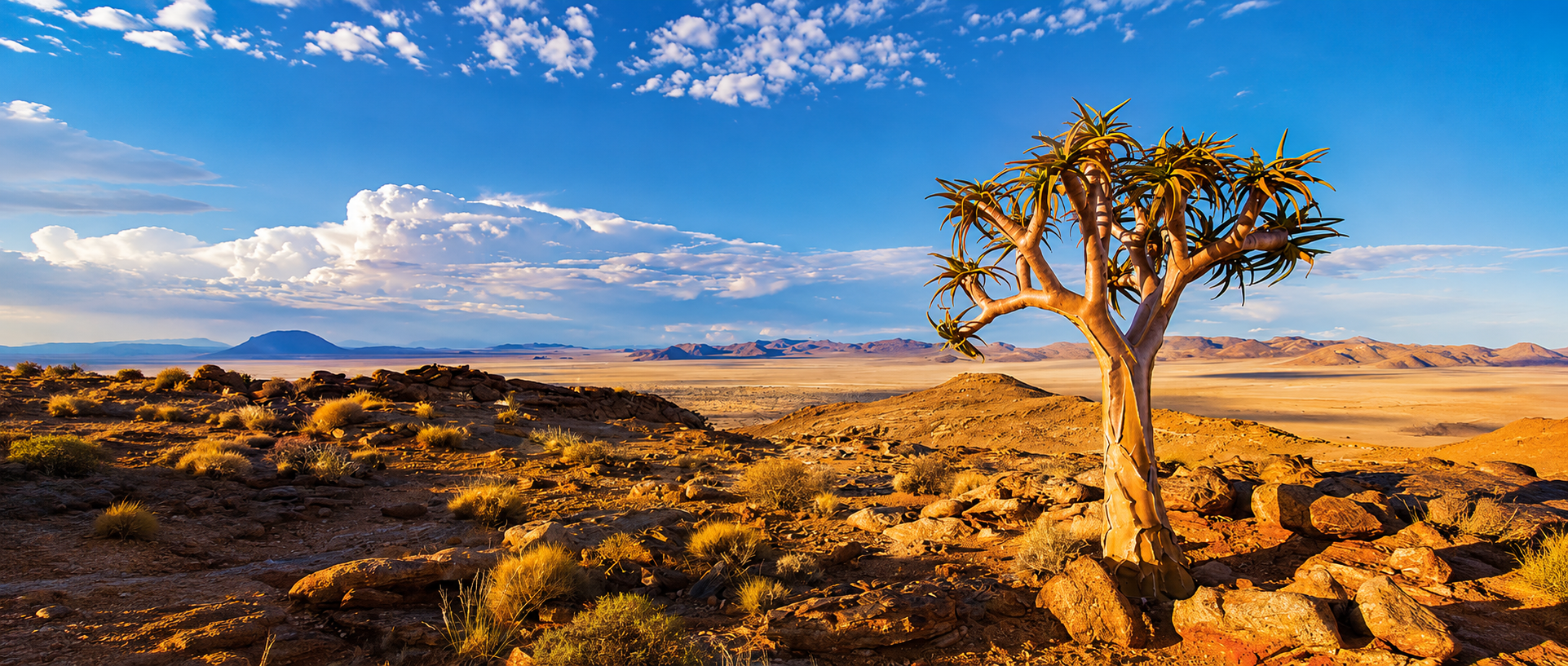
Best time to visit Namibia
Namibia is a year-round destination, but the season changes both the wildlife and the mood of the landscape. Being mostly desert, it swings between a long dry season and a short, dramatic wet season rather than hot and cold.
- May–October (dry season): The headline window. Skies are clear, malaria risk is lowest, and animals concentrate around Etosha's waterholes, making game viewing reliable. July and August are peak — superb wildlife but freezing dawns and the busiest lodges. Book well ahead.
- May & September–October (shoulders): Arguably the sweet spot — excellent wildlife, thinner crowds and slightly better value, though October gets very hot.
- November–April (green/wet season): Short, heavy afternoon thunderstorms turn the desert green and fill Etosha's pan. Wildlife scatters and is harder to spot, but it's low season with lower prices, dramatic skies, newborn animals and superb birding.
The desert highlights — Sossusvlei, the Skeleton Coast, Fish River Canyon — are spectacular in any month, so many travellers simply plan their dates around when they want to be in Etosha.
Visa & entry requirements: the new visa on arrival
- Who needs it: Nationals of the US, UK, most EU states, Canada, Australia and many others. Every traveller needs their own, including children.
- How it works: You can apply online for an e-visa before you fly, or get a visa on arrival at major ports of entry such as Hosea Kutako (Windhoek) and Walvis Bay airports. Officials strongly recommend applying online in advance to avoid airport queues.
- Cost: Around N$1,600 (roughly US$90) for travellers over 11, N$800 for children 6–11, and free for under-6s. Fees are payable by card or cash.
- Validity: The visa on arrival is issued for up to 30 days; a Holiday Visa allows up to 90 days, and you can extend at the Ministry of Home Affairs in Windhoek before it expires.
- What to bring: A passport valid for at least six months with three blank pages, a return or onward ticket, and proof of accommodation. Rules change — always confirm on the official Ministry of Home Affairs e-services portal.
Getting there & getting around
Most visitors fly into Hosea Kutako International Airport near Windhoek, usually connecting through Johannesburg, Frankfurt, Doha or Addis Ababa. Some coastal trips use Walvis Bay. Once you land, the fun begins — and in Namibia that almost always means getting behind the wheel.
- Self-drive (the classic way): Namibia has one of the best road networks in Africa. A 2WD sedan or crossover is fine for the main loop (Windhoek–Sossusvlei–Swakopmund–Etosha); you only need a 4x4 for remote regions like Damaraland, Kaokoland or the Skeleton Coast interior. Many travellers rent a fully-equipped 4x4 with a rooftop tent.
- Distances are big: Expect to cover 300+ km on many days, mostly on gravel. Fill up at every town — fuel stations are sparse between destinations and cash is sometimes needed.
- Fly-in safaris: Short flights on light aircraft link the lodges and airstrips if you'd rather not drive the long hauls — pricier, but they save days and open up the most remote camps.
- Guided tours: If gravel roads aren't your thing, small-group or private guided safaris handle all the driving and logistics.
- Skip: Public transport is limited and not designed for tourists; there's no practical train or bus network between the main sights.
Where to go: Namibia's top regions
- Sossusvlei & the Namib Desert: The star — the world's highest dunes, the surreal white clay pan of Deadvlei and sunrise climbs up Big Daddy and Dune 45. Within Namib-Naukluft National Park.
- Swakopmund & Walvis Bay: A quirky German-colonial seaside town and Namibia's adventure capital — sandboarding, quad biking, scenic flights, plus flamingos and kayaking with seals at Walvis Bay lagoon.
- Skeleton Coast: A hauntingly beautiful, fog-bound Atlantic shore of shipwrecks, seal colonies (Cape Cross) and desert meeting sea.
- Damaraland: Dramatic red rock, ancient Twyfelfontein rock art (a UNESCO site) and rare desert-adapted elephants and black rhino.
- Etosha National Park: Namibia's wildlife heart — a giant salt pan ringed by waterholes where you can sit and watch the whole cast come to drink. Superb self-drive game viewing.
- Fish River Canyon: The second-largest canyon in the world, in the far south — vast, ancient and the setting for a famous multi-day hike.
- Kolmanskop & Lüderitz: A diamond-boom ghost town being reclaimed by the dunes, next to a windswept colonial port and its wild desert horses.
- The Zambezi (Caprivi) Strip: A lush, river-fed contrast in the far northeast — the greenest, most classically 'safari' part of the country, and a gateway to Botswana and Victoria Falls.
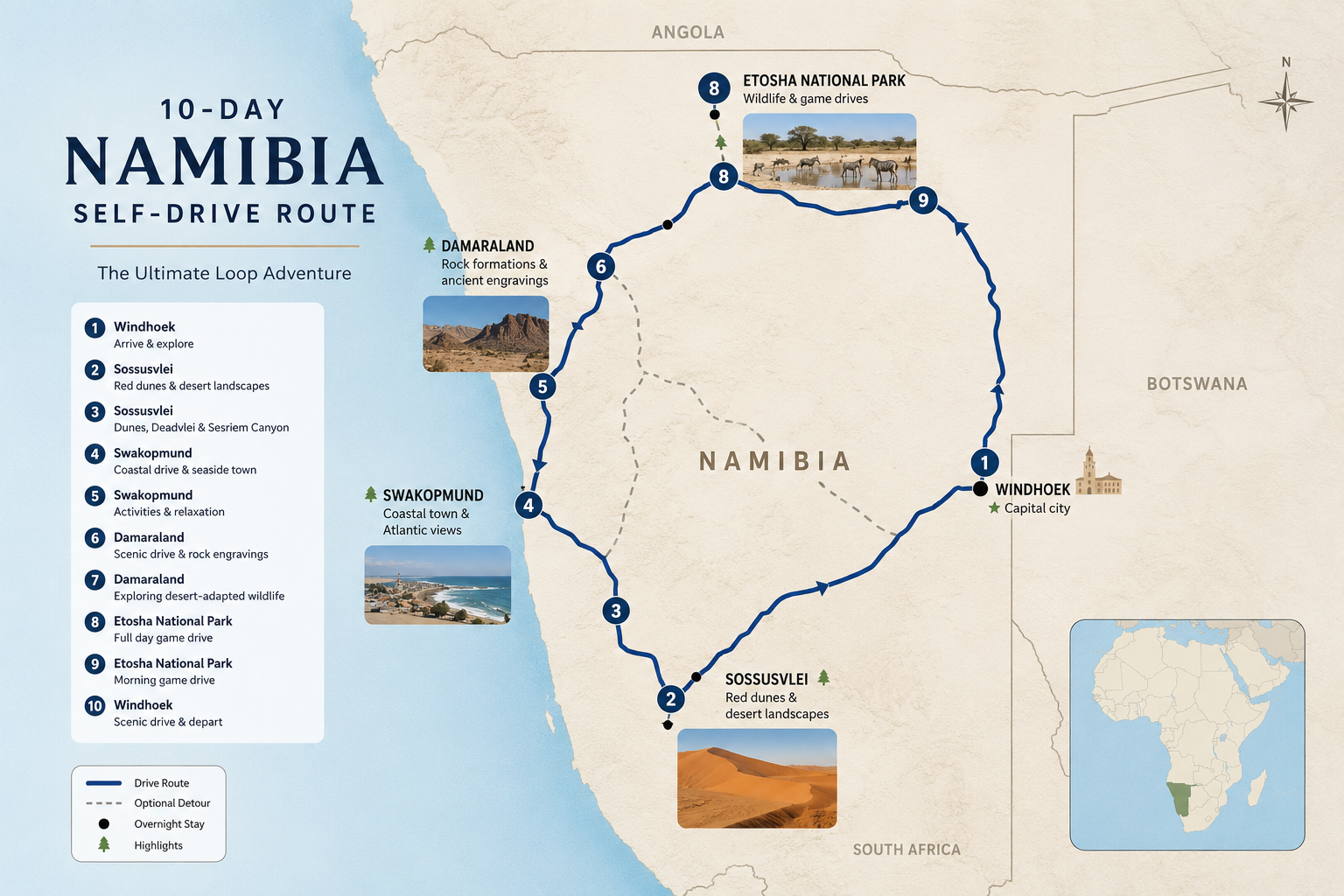
The perfect 10-day Namibia self-drive itinerary
This loop links Namibia's greatest hits with manageable driving days. Pick up your car in Windhoek and hand it back there at the end.
Day 1 — Windhoek
Arrive, collect your rental car and settle in. Stock up on supplies, water and a spare tyre check. An easy start to beat jet lag before the long drives begin.
Days 2–3 — Sossusvlei & the Namib Desert
Drive south to Sesriem. Rise before dawn to climb the great dunes and photograph Deadvlei in the first light, then explore Sesriem Canyon. Two nights lets you enjoy sunrise and sunset when the dunes glow deepest.
Days 4–5 — Swakopmund
Head to the coast via the moon-like Namib gravel plains. Swap desert silence for sea air, seafood and adrenaline — sandboarding, quad biking or a scenic flight over the dunes, plus a Walvis Bay lagoon cruise.
Days 6–7 — Damaraland
Turn inland to Namibia's most dramatic scenery. Visit the Twyfelfontein rock engravings and track desert-adapted elephants. Big skies, glowing rock and some of the country's best lodges.
Days 8–10 — Etosha National Park
Finish with the wildlife. Two or three nights of self-drive game viewing around Etosha's waterholes gives you the best odds of elephant, lion, rhino and giraffe, before the drive back to Windhoek.
How much does a Namibia trip cost? (2026)
Namibia isn't a budget destination — limited cheap accommodation and a near-mandatory rental car push costs up — but self-driving makes it far better value than a fully guided safari, especially for couples or groups splitting the vehicle. Figures below are per person, land-only, excluding international flights.
| Style | Per person / day | Accommodation | Best for |
|---|---|---|---|
| Budget / self-catering | $80–150 | Campsites, guesthouses, self-drive 2WD | Road-trippers, backpackers |
| Mid-range | $150–300 | Comfortable lodges & guesthouses, 4x4 | Most travellers |
| Luxury (lodges) | $400–700 | Premier desert & Etosha lodges | Comfort seekers, couples |
| Ultra-luxury (fly-in) | $800–1,500+ | Exclusive camps, light-aircraft transfers | Bucket-list splurge |
As a rough guide, a 10-day self-drive for two lands somewhere around US$2,600–3,500 for the pair (budget-to-mid-range, land-only), while a comparable guided or fly-in safari can easily run several times that.
Food & drink
Namibian food is hearty and carnivorous, with a strong German colonial streak alongside African staples. Try:
- Game meat: Oryx (gemsbok), kudu and springbok appear on menus everywhere — lean, flavourful and often the local specialty.
- Kapana: Street-grilled beef sold at lively township markets, dusted with chilli-and-spice mix — a Windhoek institution.
- Biltong & droëwors: Air-dried, spiced meat snacks that are the fuel of every road trip.
- Potjiekos: A slow-cooked stew made outdoors in a three-legged cast-iron pot.
- German legacy: Fresh bread, Apfelstrudel, sausage and bakeries in Swakopmund and Windhoek — plus excellent, crisp Windhoek Lager brewed to the German purity law.
- Oshifima & mahangu: A stiff millet porridge eaten with stews in the north — the everyday staple beyond the tourist trail.
Is Namibia safe? Safety & practical tips
Namibia is one of Africa's safest and most stable countries, and the vast majority of visitors have a trouble-free trip. The biggest risk isn't crime or wildlife — it's the driving.
- Stick to safe gravel-road speeds, wear seatbelts and never drive at night. Rollovers and animal collisions are the main dangers on empty roads.
- In Windhoek and Swakopmund, take normal city precautions: don't flash valuables, avoid walking alone at night and keep car doors locked in traffic.
- Carry extra water, fuel, a spare tyre and offline maps for remote stretches — you can go a long way between towns without signal.
- Protect against mosquitoes and consider antimalarials if travelling to the far north (Zambezi/Kavango) in the wet season; most of the country is low risk.
- Carry some cash in Namibian dollars (or rand) for park fees, fuel and small towns; cards work in cities and lodges but not everywhere, and rural ATMs can be empty.
What to pack & common mistakes
- Pack layers — desert dawns can be below freezing in winter while midday is hot. Add a hat, high-SPF sunscreen, sunglasses, lip balm and a good pair of binoculars.
- Bring more water and fuel than you think you'll need, plus a headtorch, basic first-aid kit and a power bank.
- Don't underestimate the distances — resist cramming in too many stops. Two or three nights per region beats a rushed dash.
- Don't skimp on car insurance, and always check your spare tyre and jack before setting off each day.
- Don't forget your e-visa before you fly — the old visa-free entry no longer applies to most Western visitors.
- Don't skip the stargazing — pack a warm layer and stay up for the Milky Way; it's one of Namibia's quiet highlights.
Frequently asked questions
Do I need a visa to visit Namibia?
Most likely, yes. Since 1 April 2025, citizens of the US, UK, EU, Canada, Australia and many other countries need a visa on arrival or e-visa (around US$90 for adults). Apply online through the official Ministry of Home Affairs portal before you fly, or get one at major airports on arrival. Your passport must be valid for six months with three blank pages.
When is the best time to visit Namibia?
May to October is the dry season and best for wildlife, especially in Etosha, with July–August the peak. The desert dunes at Sossusvlei and the Skeleton Coast are spectacular year-round, and the green season (November–April) offers dramatic skies, lower prices and great birding.
Do I need a 4x4 in Namibia?
Not always. A 2WD sedan or crossover handles the main tourist loop (Windhoek–Sossusvlei–Swakopmund–Etosha) fine, as most gravel roads are well maintained. You only need a 4x4 for remote regions like Damaraland, Kaokoland and the Skeleton Coast interior, or if you want to camp with a rooftop tent.
How many days do you need in Namibia?
Ten to fourteen days is ideal for a first self-drive trip, enough to combine the desert, coast, Damaraland and Etosha without rushing. A focused 6–7 day route (Sossusvlei, Swakopmund and Etosha) still covers the highlights.
How much does a Namibia trip cost?
Land-only and self-driving, budget travellers spend about US$80–150 per person per day, mid-range US$150–300, and lodge-based luxury US$400+. A 10-day self-drive for two typically comes to around US$2,600–3,500 for the pair. Park fees rose in April 2026 (Etosha is now about N$280 per adult per day).
Is Namibia safe for tourists?
Yes — it's one of Africa's safest, most stable countries. The main risk is driving: keep to safe speeds on gravel, never drive at night, and take full car insurance. Take normal city precautions in Windhoek and Swakopmund, and consider antimalarials only for the far north in the wet season.
Final thoughts
Few countries reward a road trip like Namibia. That first sunrise over Sossusvlei, an elephant herd materialising at an Etosha waterhole, the shipwrecks of the Skeleton Coast and a Milky Way so bright it lights the sand — all of it earned mile by mile on empty gravel roads. Sort your e-visa early, plan generous days between the big sights, take the insurance, and let the vast, silent desert do the rest. Do that, and Namibia will hand you one of the great journeys of your life.