Italy Travel Guide: Everything You Need to Know Before You Go
Italy is the ultimate culture trip — Rome’s ancient ruins, Florence’s Renaissance art, Venice’s canals and a food scene that changes with every region. Most visitors from outside Europe won’t need a visa for short stays, though the EU’s new ETIAS authorisation (about €20) is expected from late 2026. Spring (April–June) and autumn (September–October) bring the best weather and lighter crowds, while summer is hot, busy and pricey. A great first trip runs 7–10 days across the classic Rome–Florence–Venice triangle, with time to add Tuscany or the south.
It’s also one of the world’s most rewarding first-timer destinations: the sights are spectacular and easy to reach, high-speed trains link the major cities in a couple of hours, English is widely spoken, and every region rewrites the menu. This guide covers everything you need to plan a smooth, memorable Italian trip — the new ETIAS and entry rules, when to go, what it really costs in 2026, a ready-made itinerary, and the practical know-how that makes all the difference.
Why visit Italy?
- Unrivalled art & history. From the Colosseum and Pompeii to Florence’s Renaissance masterpieces and the Vatican’s Sistine Chapel, nowhere packs in more world heritage in a single country.
- A different world every hour. Rome, Florence, Venice, Naples, Milan and Bologna each feel like their own country — distinct food, dialect, architecture and character.
- Food that changes by region. Pizza in Naples, ragù in Bologna, cacio e pepe in Rome, cannoli in Sicily — eating your way across Italy is the trip in itself.
- Show-stopping landscapes. The Amalfi Coast, the Tuscan hills, the Dolomites and the northern lakes (Como and Garda) are every bit as memorable as the cities.
- A world-class 2026 calendar. The Venice Art Biennale, opera in Verona, Carnival, the Palio di Siena and a freshly upgraded post-Olympic north make this a standout year to go.
It suits first-timers, couples, art and food lovers, families, and repeat visitors ready to explore the regions beyond the big three cities.
Best time to visit Italy
Italy is a year-round destination, but the season shapes both the experience and the price. The shoulder months either side of summer are the sweet spot.
- April–June (spring): Warm days, blooming countryside, long daylight and lighter crowds than summer — arguably the best all-round window (Easter and early June can spike).
- September–October (autumn): Balmy weather, harvest season and food sagre, thinner crowds and better value — the other sweet spot.
- July–August (summer): Hot, busy and priciest; cities can swelter and many locals leave for the coast around Ferragosto (Aug 15). Best for beaches and festivals if you don’t mind the crowds.
- November–March (low season): The cheapest, quietest time — cooler and sometimes wet, but with festive Christmas markets, Alpine skiing and Venice’s Carnival in February.
Visa & entry requirements: ETIAS, EES & the Venice fee
Italy is part of the EU’s Schengen Area, and 2026 brings new digital entry steps. None are complicated, but a couple can catch travellers out.
- Who needs a visa: Citizens of the US, UK, Canada, Australia and many other countries can visit visa-free for short tourist stays of up to 90 days in any 180-day period. EU/EEA citizens travel freely.
- ETIAS (from late 2026): The EU’s new pre-travel authorisation is expected to launch in the last quarter of 2026. When live it costs €20 (free for under-18s and over-70s), is valid three years and takes minutes online at the official EU site. There’s a grace period after launch, so earlier-2026 trips don’t need it — but apply before booking flights if you travel late in the year or into 2027.
- EES biometric border: Since April 2026, Schengen borders record a photo and fingerprints instead of stamping passports. Expect this on arrival; it can mean slightly longer queues while it beds in.
- Venice access fee: Day visitors to Venice’s historic centre pay €5–10 on around 60 peak dates (clustered April–July in 2026, 8:30am–4pm). Overnight guests are exempt but must still register for a QR code. Book or register at the official portal, cda.ve.it.
- Avoid scam sites: Use only official government portals for ETIAS and the Venice fee — third-party sites add unnecessary charges.
Getting there & getting around
Most visitors fly into Rome or Milan, then travel between cities by fast train. Inside the country:
- Flying in: The main gateways are Rome Fiumicino (FCO) and Milan (Malpensa and Linate); Venice, Naples, Bologna and Pisa also handle international flights.
- High-speed trains: The easiest way to travel — Trenitalia’s Frecciarossa and private rival Italo connect the big cities centre-to-centre (Rome–Florence ~1.5h, Rome–Naples ~1h, Florence–Venice ~2h). Book a few weeks ahead for the cheapest fares.
- Regional trains: Slower and cheaper for short hops; validate or activate the ticket before boarding to avoid a fine.
- Driving: Ideal for Tuscany, Puglia, Sicily and the Dolomites — but avoid city centres, where camera-enforced ZTL zones trigger automatic fines that arrive months later. Park outside and walk or use transit.
- In cities: Rome and Milan have metros and most centres are walkable. Use official white taxis or apps like FreeNow — and skip unlicensed drivers touting at stations.
Where to go: Italy’s top cities & regions
- Rome: The eternal anchor — Colosseum and Forum, the Vatican and Sistine Chapel, the Pantheon and Trevi Fountain, layered over 3,000 years.
- Florence & Tuscany: Renaissance art (the Uffizi, David, the Duomo) and a countryside of vineyards, cypress roads and hill towns like Siena and San Gimignano.
- Venice & the Veneto: Canals, St Mark’s, the Biennale and water festivals — with Verona and the Dolomites within easy reach.
- Naples & the Amalfi Coast: The birthplace of pizza and the gateway to Pompeii, Capri, Positano and Sorrento.
- Milan & the Lakes: Fashion, design and Leonardo’s Last Supper, with Lake Como and Lake Garda a short train away.
- Sicily & Puglia: The south’s great-value stars — Greek temples, Baroque towns, whitewashed trulli, coastline and volcanoes.
- Bologna & Emilia-Romagna: Italy’s food heartland — arcaded streets, ragù, Parmigiano and prosciutto.
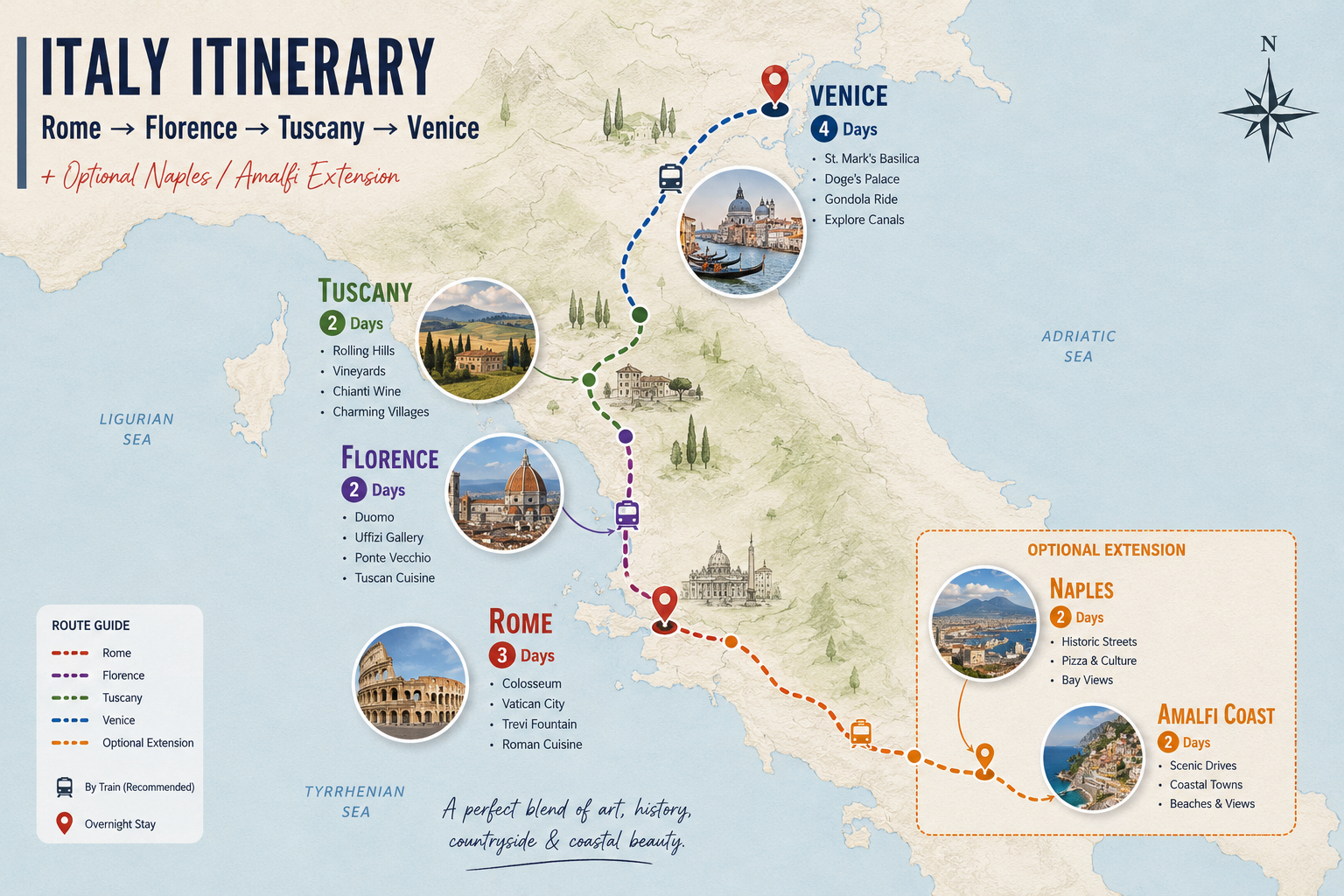
The perfect 7–10 day Italy itinerary
This route blends Italy’s greatest cities with a taste of the countryside, all linked by fast trains. Book high-speed tickets ahead and travel light — you’ll be hauling bags over cobblestones.
Days 1–3 — Rome
Start in the capital. Give it three nights for the Colosseum and Roman Forum, the Vatican Museums and Sistine Chapel, the Pantheon, Trevi Fountain and long evening walks through the historic centre, fuelled by the city’s four great pastas.
Days 4–5 — Florence & Tuscany
Take the fast train north (about 1.5 hours). Two nights covers the Uffizi, Michelangelo’s David, the Duomo and Ponte Vecchio, with a day trip into the Tuscan hills for wine, Siena or San Gimignano.
Days 6–7 — Venice
Continue to Venice (around two hours). Two nights is enough to lose yourself in the canals, see St Mark’s and the Doge’s Palace, ride the vaporetto to Murano and Burano, and — in 2026 — take in the Art Biennale.
Days 8–10 — Naples & the Amalfi Coast (optional extension)
With extra days, head south from Rome to Naples for pizza in its birthplace, then Pompeii and the cliffside villages of the Amalfi Coast — a dramatic contrast to the northern cities.
How much does a trip to Italy cost? (2026)
Italy sits in Europe’s mid-range — pricier than Portugal or Greece, cheaper than Switzerland or much of France — and it delivers outstanding value on food and wine. The biggest variables are region and season. Figures below are per person, land-only (excluding international flights).
| Style | Per person / day | Accommodation | Best for |
|---|---|---|---|
| Budget | €60–90 | Hostels, B&Bs, casual trattorias | First-timers, backpackers |
| Mid-range | €120–180 | 3-star hotels or agriturismi, sit-down meals | Most travellers |
| Comfort | €250–400 | Boutique or 4-star, some fine dining & tours | Couples, special trips |
| Luxury (all-in) | €450+ | 5-star palazzo hotels, private guides & transfers | Bucket-list splurge |
As a rough guide, a 7-day mid-range trip lands around €1,500–2,500 per person land-only, while a comfortable two-week trip runs €3,000–5,000+. Venice, the Amalfi Coast, Lake Como and Milan sit 20–40% above Rome or Florence; Naples, Bologna, Puglia and Sicily are noticeably cheaper. Travelling in shoulder season can cut 30–50% off almost everything.
Food & drink
Italian food is intensely regional — there’s no single national dish, and the cooking changes every region and often every town. A few things to seek out:
- Pizza napoletana — the UNESCO-listed original, best in its Naples birthplace, blistered and soft.
- The Roman pastas — cacio e pepe, carbonara, amatriciana and gricia, the four pillars of Roman cooking.
- Tagliatelle al ragù — Bologna’s real “bolognese,” plus tortellini in brodo and proper lasagne.
- Bistecca alla fiorentina — Tuscany’s towering, rare T-bone steak, ideally with a glass of Chianti.
- Sicilian sweets — cannoli, cassata and granita with brioche for a very Sicilian breakfast.
- Aperitivo, gelato & espresso — the daily rituals: a spritz with snacks before dinner, gelato on an evening stroll, and espresso taken standing at the bar.
Is Italy safe? Safety & practical tips
Italy is a very safe, well-trodden destination and the vast majority of visitors have a trouble-free trip. Travel sensibly rather than nervously and you’ll be fine.
- Petty theft is the main risk: pickpocketing and bag-snatching in tourist crowds, on packed buses and metros, and around big stations like Rome’s Termini. Keep valuables zipped and out of back pockets.
- Know the common scams: the “free” bracelet or rose, the overly helpful stranger at a ticket machine, and taxis without a meter. A polite “no, grazie” and walking on handles most of them.
- Use official transport: take licensed white taxis or a ride app, and agree the fare or insist on the meter.
- Everyday health: tap water is safe, and pharmacies (farmacia) are excellent for minor ailments and advice.
- Emergencies: the single European emergency number is 112, and it’s answered in English.
What to pack & common mistakes
- Wear the right shoes: comfortable, broken-in footwear is essential — you’ll walk miles on cobblestones.
- Cover up for churches: bring something that covers shoulders and knees for major churches and the Vatican.
- Pack for the season: layers for spring and autumn, breathable fabrics for summer heat, a compact umbrella, and a smart-casual outfit for evenings (Italians dress well).
- Don’t overpack the itinerary: two or three bases done well beats a rushed six-city dash.
- Don’t drive into city centres: ZTL cameras issue automatic fines — and don’t forget to validate regional train tickets.
- Don’t forget the paperwork: if you’re travelling late 2026 or into 2027, sort your ETIAS before you fly.
Frequently asked questions
Do I need a visa to visit Italy?
Many nationalities — including US, UK, Canadian, Australian and EU citizens — don’t need a visa for short tourist stays of up to 90 days in any 180-day period. From late 2026 the EU is expected to require ETIAS, a quick online authorisation costing €20, before travel. Check whether it’s live for your dates and apply only at the official EU site.
When is the best time to visit Italy?
April–June and September–October offer the best mix of good weather and manageable crowds. July–August are the hottest and busiest; November–March are the cheapest and quietest, with Carnival and Alpine skiing as winter highlights.
How many days do you need in Italy?
Seven to ten days is ideal for a first trip — enough for the Rome–Florence–Venice triangle with time for Tuscany or a southern extension. A long weekend in a single city also works beautifully.
Is Italy safe for tourists?
Yes. Violent crime is rare; the main concern is pickpocketing in crowded tourist areas and on public transport. Stay alert with your valuables and you’ll almost certainly have a trouble-free trip. The emergency number is 112.
How much does a trip to Italy cost?
Land-only, budget travel runs about €60–90 per person per day, mid-range €120–180, and luxury €250–400+. Venice and the Amalfi Coast cost more; Naples, Bologna and the south are cheaper. Shoulder-season travel can save 30–50%.
What’s the food like — and do I tip?
Superb and intensely regional — eat where the menu is short and seasonal. Tipping isn’t expected: many restaurants add a small coperto (cover charge), and simply rounding up for good service is plenty.
Final thoughts
Few countries reward a traveller like Italy — a morning among Roman ruins, an afternoon over handmade pasta, an evening watching the light change on a Renaissance piazza. Plan your dates around the weather and the 2026 calendar, sort any entry paperwork early, resist the urge to cram in too much, and leave room to linger over long lunches. Do that, and Italy will give you the trip of a lifetime.